Giac Vien Pagoda
Giac Vien Pagoda
Built in 1798 near Dam Sen Lake, Giac Vien Pagoda is one of the oldest Buddhist sanctuaries in Ho Chi Minh City, rich in wooden statuary.
Giac Vien Pagoda is one of the oldest Buddhist sanctuaries in Ho Chi Minh City. Located in District 11, near Dam Sen Lake, it preserves an atmosphere of contemplation away from the classic tourist circuits of downtown. Its interior houses a wealth of carved wooden statuary and panels engraved with epitaphs, making it a precious witness to southern Vietnamese Buddhism.
Why visit Giac Vien Pagoda
Unlike the more frequented temples in central Saigon, Giac Vien remains a living place of worship little altered by tourism. Several reasons warrant a visit:
- Remarkably complete Buddhist statuary, with over one hundred wooden representations
- Architecture similar to that of Giac Lam Pagoda, its sister pagoda, considered one of the oldest in the city
- A peaceful atmosphere, near Dam Sen Park and Lake
- Historical interest linked to the Nguyen Dynasty
The visit will particularly interest travelers drawn to religious art and the history of South Vietnam.
History of the Pagoda
Giac Vien Pagoda was built in 1798 beside Dam Sen Lake. It shares numerous architectural similarities with Giac Lam Pagoda, located nearby. It was indeed a Buddhist monk from the latter, Hai Thin, who undertook its restoration before transferring its management to his disciple Hoan Ngai.
In all likelihood, Emperor Gia Long, founder of the Nguyen Dynasty, regularly visited the pagoda before his death in 1819. This oral tradition, still relayed by the monks of the place, anchors Giac Vien in Vietnam's great imperial history.
Today, the pagoda still welcomes a community of monks who conduct daily services and maintain the sanctuary.
What to see inside
The main hall and central platform
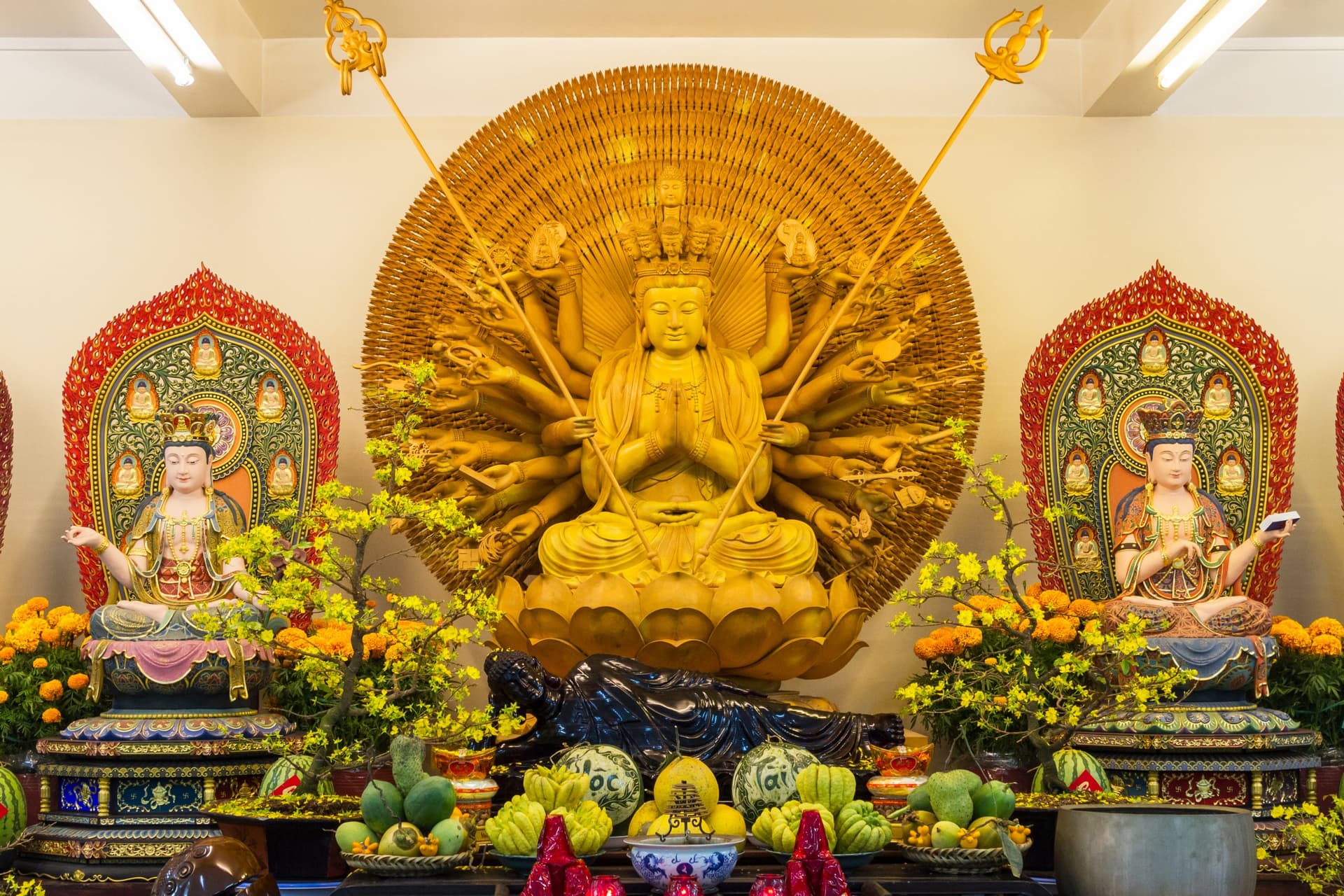
The interior of Giac Vien stands out for the density of its statuary and woodwork. Amid panels adorned with epitaphs, several major figures from the Buddhist pantheon face one another:
- Chuan De, depicted with her eighteen arms
- A Di Da, the Buddha of the past
- Buddha Thich Ca, accompanied by his two disciples Anand and Kasyape
- Ameda, the laughing Buddha
Facing the platform stands a copper incense burner from which two dragon heads emerge, a centerpiece of the central decoration.
The side altars and aisles
Two altars frame the main hall: Dai The Chi Bo Tat crowns the left one, while Quan The Am Bo Tat (the goddess of mercy) occupies the right one. The pagoda's guardian leans against the wall facing the platform.
Along the side walls unfold two particularly interesting iconographic series: the judges of the ten infernal regions on one side, and eighteen bodhisattvas on the other. This ensemble offers a rare visual panorama of Mahayana Buddhist cosmology as interpreted in Vietnam.
Practical information
- Location: District 11, Ho Chi Minh City, near Dam Sen Park
- Hours: the pagoda is generally open daily, from morning until late afternoon
- Admission: free entry, donations appreciated
- Visit duration: allow 30 to 45 minutes to tour the entire sanctuary
- Dress code: clothing covering shoulders and knees, out of respect for this place of worship
Avoid prayer times if you wish to move freely, and remain discreet in the presence of worshippers.
How to get there
The pagoda is located in District 11, approximately 6 km from Ben Thanh Market. Several options are available:
- By taxi or ride-sharing (Grab): the easiest option from the center, expect 15 to 25 minutes depending on traffic
- By motorcycle taxi: practical for short trips, to be negotiated before departure
- By city bus: several routes serve the Dam Sen neighborhood
The visit can be combined with Dam Sen Park, located a few steps away, or with Giac Lam Pagoda, its architectural counterpart about 3 km away.
What to see nearby
Ho Chi Minh City and southern Vietnam offer many sites to complement a visit to Giac Vien:
- The Cai Rang floating market, in the Mekong Delta, to discover traditional river commerce
- Buu Long Mountain, a natural area on the outskirts of Ho Chi Minh City
- The Ba Den Mountain, the southernmost peak in the country and an important pilgrimage site
Frequently asked questions
Frequently asked questions
It is situated in District 11 of Ho Chi Minh City, near Dam Sen Lake and Park, approximately 6 km from the center.
The two pagodas share very similar architecture and linked history. Giac Lam is older and more well-known, while Giac Vien, founded in 1798 and restored by a monk from Giac Lam, remains more intimate.
No, access is free. A donation for the maintenance of the site is appreciated but not mandatory.
Allow approximately 30 to 45 minutes to observe the statuary and aisles, longer if you wish to extend your visit to the neighboring Dam Sen Park.
Preparing your trip
Giac Vien Pagoda naturally fits into a cultural itinerary in Ho Chi Minh City, alongside the city's other historic pagodas. To build a tailor-made stay including this spiritual stop and many other discoveries, consult our Vietnam trips designed by our local specialists.

Interested in this visit?
We can include it in your personalised itinerary.