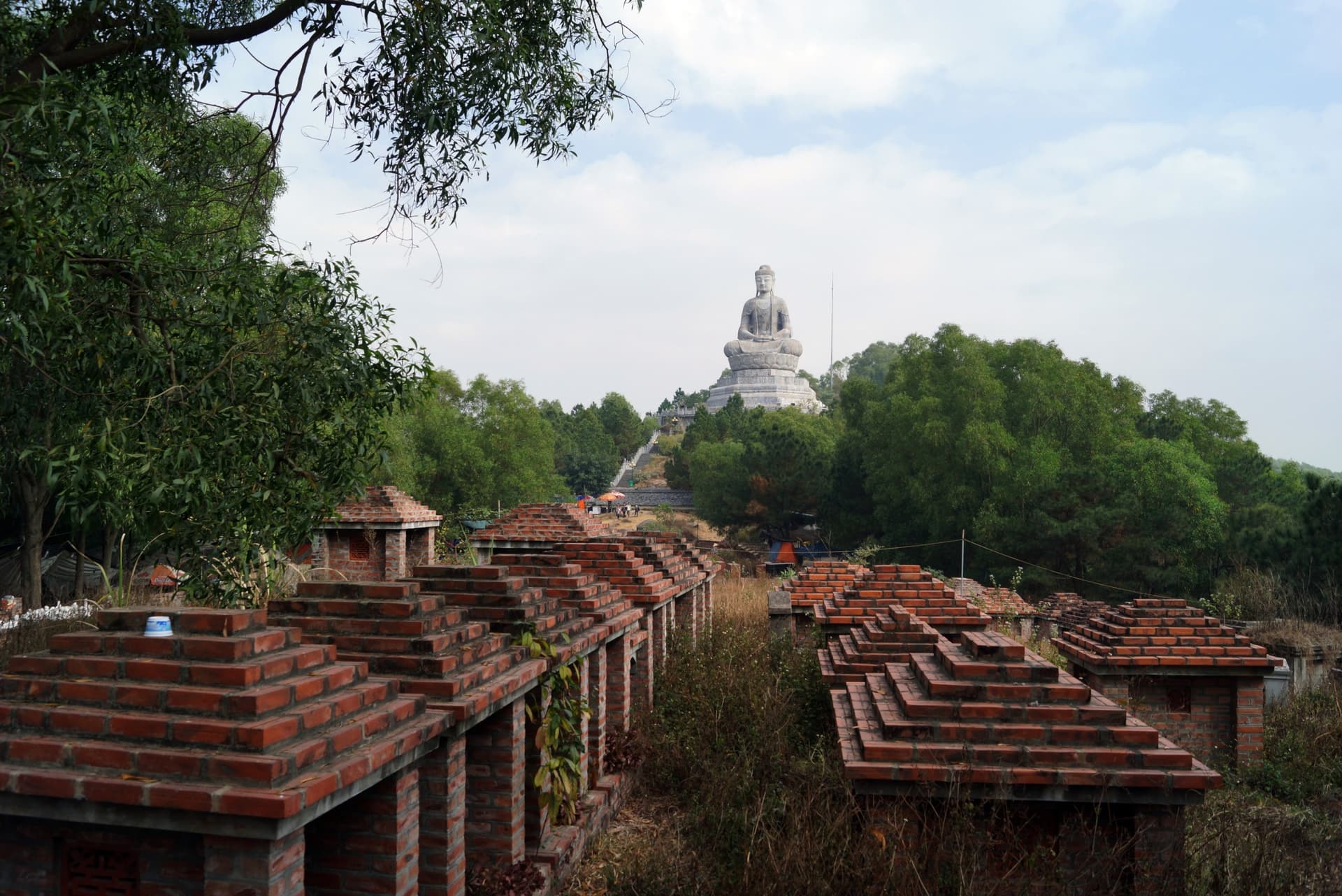
Phat Tich Pagoda
Phat Tich Pagoda
Located 30 km from Hanoi, Phat Tich Pagoda houses one of Vietnam's oldest monumental Buddhist statues, nestled in a wooded hillside setting.
Phat Tich Pagoda (Chùa Phật Tích) rises at the foot of Lan Kha Mountain in Bac Ninh Province, roughly thirty kilometers east of Hanoi. This Buddhist sanctuary ranks among the oldest places of worship in the Red River Delta and preserves, despite successive destruction, several sculptures classified as national treasures of Vietnam.
Why visit Phat Tich Pagoda
Phat Tich offers rare testimony to Vietnamese Buddhist art from the Ly and Tran dynasties. The site combines several interests for visitors:
- An 11th-century stone Amitabha statue, considered one of the oldest monumental Buddhist sculptures preserved in Vietnam.
- A procession of carved animals (lions, elephants, rhinoceroses, buffalo, horses) dating from the Ly dynasty, arranged at the sanctuary's entrance.
- A wooded hillside setting conducive to exploration, with a large contemporary Amitabha statue erected at the summit.
- A calmer atmosphere than the tourist pagodas in central Hanoi, particularly on weekdays.
The visit fits naturally into a half-day excursion from the capital, often combined with other Buddhist sites in Bac Ninh Province.
History of the Pagoda
Historical records place Phat Tich's foundation between the 7th and 10th centuries, on a site already associated with Buddhism's spread throughout northern Vietnam. However, the sanctuary took on its historical form under the Ly dynasty (11th-13th century), a period during which it was renovated and enhanced with royal court support.
In 1057, King Ly Thanh Tong commissioned the construction of a tower intended to house precious objects as well as a gilded Buddha statue. The great stone Amitabha statue still preserved today in the main sanctuary also dates from this period.
The pagoda suffered serious damage in 1947 during the Indochina War and was subsequently abandoned for several decades. It underwent faithful restoration completed in 1991, followed by more recent expansions including the large Amitabha statue on the hillside.
A center of Ly culture
Bac Ninh Province constituted the cradle of the Ly dynasty and remains renowned for Quan Ho singing, a traditional vocal genre inscribed on UNESCO's Intangible Cultural Heritage list. Phat Tich participates in this cultural heritage and hosts an annual religious festival each early spring, attracting pilgrims and residents from surrounding villages.
What to see on site
The stone Amitabha statue
The site's masterpiece, this sculpture stands roughly 1.80 meters high and depicts the Buddha Amitabha seated in meditation upon a lotus-shaped throne. The stonework, attributed to Ly court artisans, displays particular refinement in the drapery and facial features.
The animal sculptures
Arranged in two rows along the central passage, ten sculptures represent five animal species in symmetric pairs. This ensemble, unique to Vietnam, echoes the processional pathways of Buddhist temples across Asia.
The Sakya Mouni Buddha statue
The pagoda also preserves a blue stone statue of Buddha Sakya Mouni, as well as a carved relief depicting musicians and dancers, testament to the celestial iconography developed under the Ly.
The large Amitabha statue
Atop the hillside, accessible by stone steps, a large contemporary Amitabha statue dominates the plains. The viewpoint offers an unobstructed perspective over the surrounding rice fields.
Practical Information
- Location: Phat Tich Commune, Tien Du District, Bac Ninh Province.
- Visit duration: allow 1.5 to 2 hours for the sanctuary, sculptures, and ascent to the hilltop statue.
- Admission: free entry, donations welcome.
- Dress code: shoulders and knees covered, as in all Vietnamese places of worship.
- Best season: autumn (October-November) and spring (March-April) offer pleasant conditions; the annual festival falls on the 4th day of the 1st lunar month.
How to get there from Hanoi
The pagoda lies approximately 25 km east of Hanoi, roughly 45 minutes to 1 hour by road depending on traffic. Several options are available:
- Private car with driver: the simplest solution, allowing you to combine Phat Tich with other Bac Ninh sites (But Thap Pagoda, Do Temple).
- Taxi or ride-sharing service: direct journey from central Hanoi, arrange your return in advance.
- Motorbike: feasible route for experienced travelers, via National Road 1 then secondary roads.
Direct public transport is limited; a bus change at Bac Ninh town is typically necessary.
What else to explore in the region
Bac Ninh Province and the Red River Delta hold other worthwhile sites to extend your excursion. Travelers on longer circuits may then proceed to other parts of the country, such as Cát Bà Bay and its biosphere reserve, or explore the south with Cai Rang floating market and the Cham sculpture museum in Da Nang.
Plan your journey
Phat Tich Pagoda fits naturally into a discovery of northern Vietnam's Buddhist heritage. To build a custom itinerary incorporating Hanoi, Bac Ninh, and other regions, explore our Vietnam journeys crafted with our English-speaking local agents.

Nearby

Interested in this visit?
We can include it in your personalised itinerary.