The Imperial Tombs
The Imperial Tombs
Southwest of Hué, the tombs of the Nguyen emperors form a UNESCO-listed ensemble blending funerary architecture, gardens and lotus ponds.
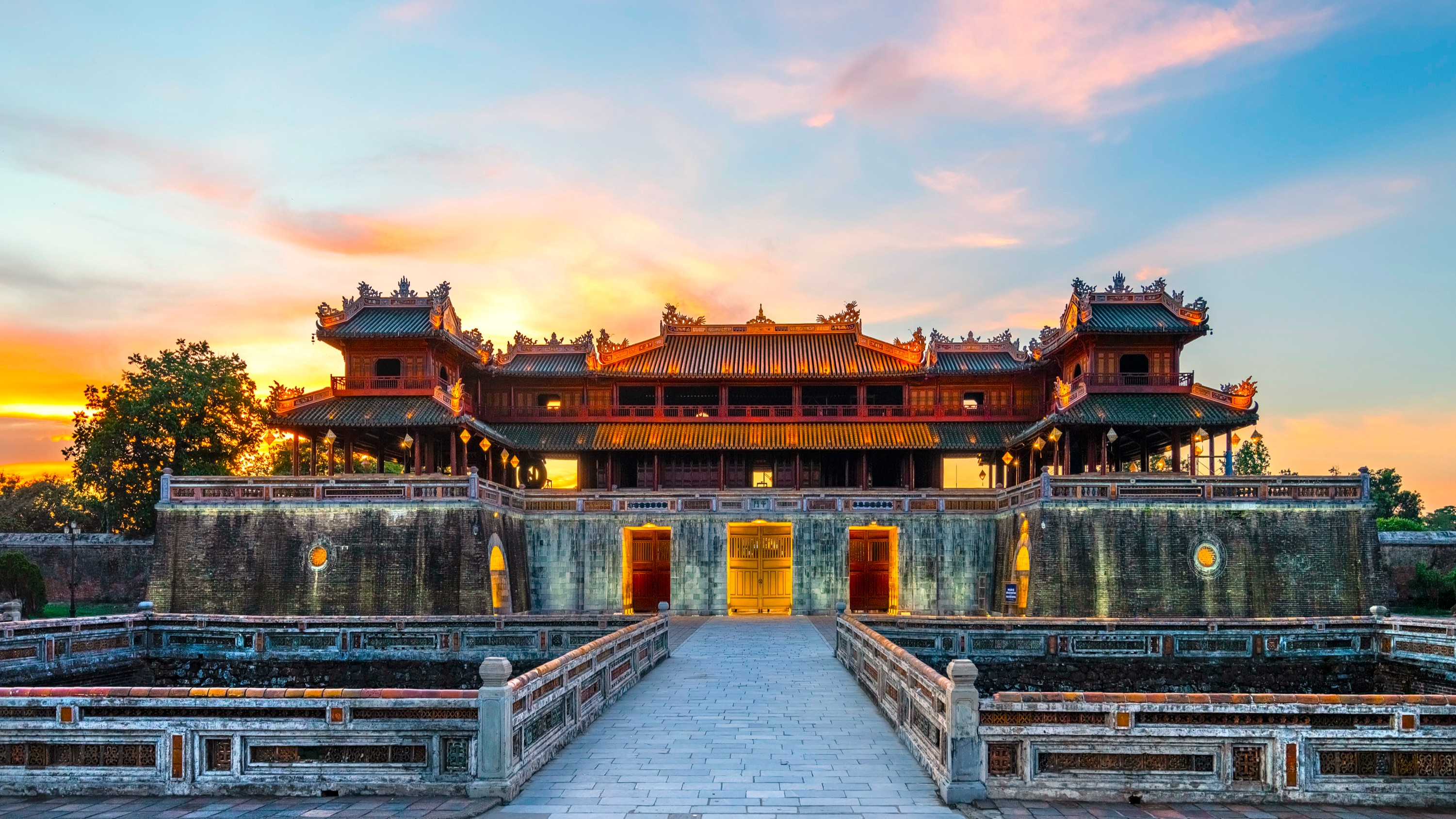
Southwest of Hué, the former imperial capital of Vietnam, the tombs of the Nguyen emperors stretch across the countryside crossed by the Perfume River. These funeral complexes, serving both as sepulchers and imperial retreat residences, were designed during the emperors' lifetimes between the early nineteenth century and the first half of the twentieth. They are part of the Hué monuments ensemble, inscribed on UNESCO's World Heritage list since 1993.
Why visit the imperial tombs?
Visiting the Nguyen tombs means reading the history of Vietnam's last dynasty through stone, wood and gardens. Each site combines funerary architecture, worship spaces, pavilions and basins, in a dialogue with the landscape ordered by geomancy. Unlike a museum visit, the experience unfolds outdoors, across vast domains where you move on foot between stelae, temples and lotus ponds.
- A complete panorama of the Nguyen dynasty (1802-1945), Vietnam's final imperial house.
- Contrasting architectures from one tomb to another, reflecting different personalities and periods.
- A carefully designed landscape setting, incorporating hills, ponds and ornamental plantings.
- A visit that combines naturally with the Citadel of Hué and the Perfume River.
History and context
The Nguyen dynasty, founded in 1802 by Emperor Gia Long, ruled a unified Vietnam from Hué until Bao Dai's abdication in 1945. Of the thirteen emperors in the lineage, seven have monumental tombs in the Hué region, while others lacked the time, means, or political legitimacy to have theirs built.
Each tomb was conceived as a residence in the afterlife, but also as a retreat that the emperor would visit during his lifetime. Thus two distinct spaces are found: a sector dedicated to worship, with temple and stele pavilion, and the actual tomb, often isolated behind an enclosure wall. The buildings are surrounded by lotus ponds, artificial mounds and ornamental plants, according to feng shui principles applied to the funerary site.
The ensemble of tombs, like the Citadel and pagodas of Hué, suffered damage from twentieth-century conflicts, particularly during the Tet Offensive in 1968. Restoration campaigns supported by UNESCO and several international partners have stabilized the structures and progressively reopened the sites to the public.
What to see on site?
Practically all tombs were built southwest of the Hué Citadel, along or near the Perfume River. Each tomb reflects its own architecture, according to the aspirations, aesthetic conceptions and personality of the king who rests there. Four sites concentrate most of the visits.
The Tomb of Tu Duc
Completed in 1867, it is the most extensive and most poetic. Emperor Tu Duc, a scholar and poetry enthusiast, regularly stayed there during his lifetime. The domain is organized around a large pond, Luu Khiêm, dotted with wooden pavilions where the sovereign composed his verses. The tomb itself lies apart, in a wooded area.
The Tomb of Minh Mang
Built between 1840 and 1843, it embodies the pinnacle of Confucian funerary architecture in Vietnam. The plan is rigorously symmetrical, organized along an axis several hundred meters long alternating courtyards, bridges, temples and basins. It is one of the most harmonious sites in the ensemble.
The Tomb of Khai Dinh
Constructed between 1920 and 1931, it stands in sharp contrast to the others. Emperor Khai Dinh employed imported materials (concrete, slate, wrought iron) and a vocabulary blending European and Asian influences. The interior chamber, adorned with mosaics of porcelain and glass, is remarkable.
The Tomb of Gia Long
More remote and less frequented, it houses the dynasty's founder. The site, more understated, appeals through its preserved natural setting and peaceful atmosphere. It suits visitors who wish to avoid crowds.
Practical information
- Duration of visit: allow 1 to 1.5 hours per tomb, and a half-day to a full day to visit three or four in succession.
- Ticketing: each tomb has its own ticket, and combined packages including the Hué Citadel are offered at favorable rates.
- Best period: February to April, when temperatures remain mild and rainfall moderate. Summer is hot and humid, autumn marked by showers.
- To bring: comfortable shoes (the domains are vast and include stairs), water, hat and sun protection.
- Respect for the sites: these are funeral and religious sites; clothing covering shoulders and knees is appropriate.
How to get there?
The tombs are located between 4 and 16 kilometers southwest of central Hué. Several options allow you to organize the visit at your own pace.
- By boat on the Perfume River: full-day excursions combine navigation, Thien Mu pagoda and stops at the tombs of Minh Mang and Tu Duc. This is the most picturesque approach.
- By bicycle or scooter: secondary tracks between the tombs cross rice paddies and villages, a choice appreciated by independent travelers.
- By private car with driver: the fastest option to visit three or four sites in a day, with reduced waiting times.
- By taxi or ride-sharing: feasible for one or two sites, but impractical for a complete loop.
What to see in the region and beyond
A visit to the tombs forms part of a broader Vietnam itinerary. In Hué itself, the Citadel, Thien Mu pagoda and Dong Ba market enhance immersion in Nguyen heritage. Moving south toward the country's center, several stops merit a detour.
- The Cham Sculpture Museum in Da Nang, to understand the civilization that preceded the Viet in this part of the country.
- Cát Bà Island, a biosphere reserve in the north, for a nature break after Hué's heritage richness.
- Cai Rang Floating Market, in the Mekong Delta, for contrast with the imperial world.
- Ba Den Mountain, a major pilgrimage site in the country's south.
Prepare your trip
The Nguyen tombs constitute a major stop on any tour of central Vietnam. To build an itinerary combining Hué, Halong Bay, Hoi An and the Mekong Delta, consult our bespoke Vietnam journeys, designed with our English-speaking local agents.
Interested in this visit?
We can include it in your personalised itinerary.