Trang An
Trang An
100 km south of Hanoi, the karst complex of Trang An, a UNESCO World Heritage site, is explored by traditional sampan along three itineraries combining caves and temples.
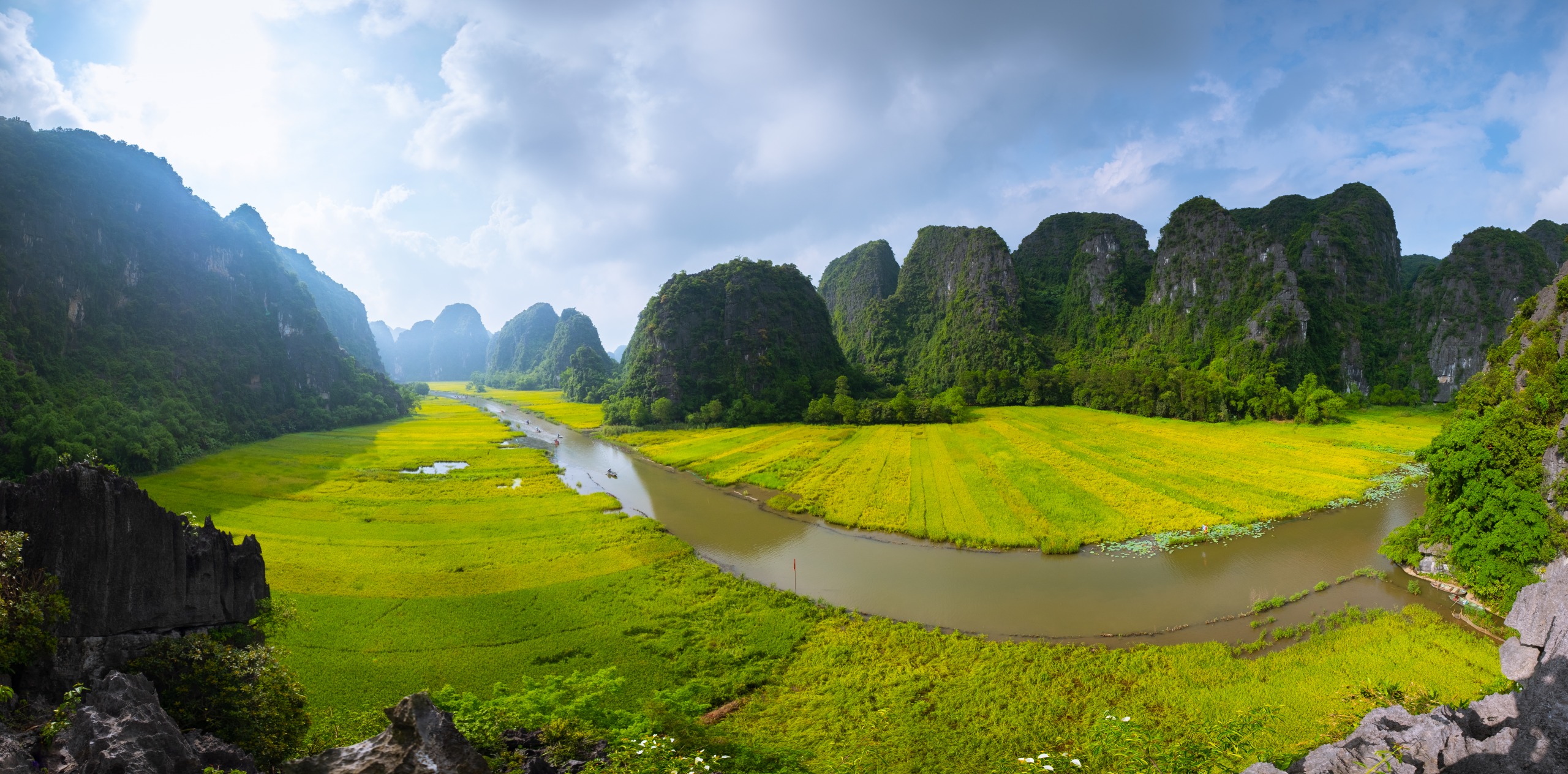
100 km south of Hanoi, in Ninh Binh province, Trang An unfolds a landscape of karst peaks crisscrossed by a network of rivers and caves. Inscribed on the UNESCO World Heritage list since 2014 as a mixed site (natural and cultural), the complex is explored exclusively by traditional sampan along three marked itineraries combining caves, spiritual sites and limestone formations.
Why visit Trang An
Trang An is one of the rare sites in the world recognized by UNESCO for both its natural and cultural qualities. Its appeal lies in several concrete elements:
- A karst massif spanning more than 6,000 hectares, comparable to Ha Long Bay but in a continental setting — hence the nickname "terrestrial Ha Long Bay."
- A boat journey that passes through flooded caves, sometimes stretching for several hundred meters.
- Strong historical significance: the area encompasses the ancient imperial capital Hoa Lu and several active temples.
- Easy accessibility from Hanoi, allowing for a 2-day/1-night visit or even a day excursion.
History of the site
Human occupation of Trang An dates back approximately 30,000 years, as evidenced by remains discovered in high-altitude caves. These traces document the adaptation of hunter-gatherers to climate variations of the late Pleistocene, particularly to rising sea levels that shaped the current karst valleys.
In the 10th century, the region was home to Hoa Lu, the ancient capital of Vietnam under the Dinh and earlier Le dynasties. The strategic choice of this site, protected by limestone massifs, marked the country's unification after prolonged Chinese domination. When the capital was transferred to Thang Long (present-day Hanoi) in 1010, Hoa Lu retained religious and symbolic significance. Trang An preserves from this period a collection of temples, pagodas and sanctuaries integrated into the landscape.
What to see and do
Boat excursions
Exploration takes place exclusively in oared sampans, each boat accommodating up to six passengers. Three official itineraries are offered from the main boat landing:
- Itinerary 1: 9 caves and 3 spiritual sites, expect 3.5 to 4.5 hours of navigation.
- Itinerary 2: 4 caves and 3 spiritual sites, approximately 2.5 to 3 hours.
- Itinerary 3: 3 caves and 3 spiritual sites, 3 to 3.5 hours, including the Kong studio used for filming Kong: Skull Island.
If traveling with fewer than six people, you will share the boat with other visitors. It is possible to reserve the entire sampan by purchasing all six seats.
The caves
Trang An has 48 caves, only part of which are accessible depending on the chosen itinerary. The Ba Giot cave is renowned for its active stalactites and stalagmites. The Nau Ruou cave ("alcohol cave") owes its name to a spring that allegedly served to distill a local rice alcohol. Several passages require bending low, in near-total darkness interrupted only by the glow of the rowers' lamps.
Temples and heritage
The route reaches several spiritual sites, notably the Trinh and Tran temples, dedicated to dignitaries of the Dinh dynasty. Boats stop to allow a brief on-foot visit, useful for understanding the intertwining of landscape and worship.
The Kong: Skull Island village
On itinerary 3, the 2017 film set has been preserved: bamboo huts, totems, tribal staging. It's a brief stop, rather anecdotal, but popular with families and film enthusiasts.
Practical information
Access to the complex is by combined ticket including the boat ride. Prices distinguish adults and children by height, with free admission for the youngest. Budget moderate for entry, significantly more if you privatize the boat. The site is open from morning until early afternoon; it is advisable to arrive early to avoid queues at the landing, especially during high season.
Bring a hat, water and sunscreen: the boat offers only partial protection. A tip for the rower is customary at the end of the journey.
When to go
The dry season, from November to April, remains the most comfortable period: moderate temperatures, low rainfall probability, optimal visibility of the peaks. The rice paddies at the base of the cliffs turn golden yellow in late May-early June, just before harvest — a short but photogenic window, especially in the nearby Tam Coc area.
Avoid if possible weekends and Vietnamese public holidays (Tet in late January-February, National Day in early September), which draw heavy local crowds. Visiting on weekdays outside school holidays ensures a calmer experience.
How to get there
Trang An is located 7-10 km from Ninh Binh city center, accessible by several means:
- By taxi or Grab: short journey from Ninh Binh, reasonable fare. Check that the meter is running.
- By rented motorcycle or scooter: the most flexible solution for combining Trang An with other nearby sites. Daily rentals available at most accommodations.
- By bicycle: feasible from Tam Coc or Ninh Binh, the road is flat and traffic moderate.
- From Hanoi: train or bus to Ninh Binh (approximately 2 hours), then local transfer. Many operators also offer all-inclusive day excursions.
Nearby attractions
Ninh Binh concentrates several sites complementary to Trang An, worth combining over 2 or 3 days:
- Hoa Lu: the ancient imperial capital, 5 km away, with its Dinh Tien Hoang and Le Dai Hanh temples.
- Tam Coc: another boat ride on the Ngo Dong river, passing through rice paddies and three successive caves.
- Bai Dinh Pagoda: Vietnam's largest Buddhist complex, about ten kilometers away.
- Mua Cave: 500 steps lead to a panoramic viewpoint over Tam Coc and the karst valley.
To further explore North Vietnam's spiritual heritage, the Do temple in Bac Ninh province or the Perfume Pagoda southwest of Hanoi are worthwhile stops.
Frequently asked questions
Frequently asked questions
Organize your trip
Trang An naturally fits into a North Vietnam itinerary combining Hanoi, Ha Long Bay and Ninh Binh. To build a custom itinerary integrating these stops, consult our Vietnam tours.
Interested in this visit?
We can include it in your personalised itinerary.