Buu Long Mountain and Long An
Buu Long Mountain and Long An
About thirty kilometers from Ho Chi Minh City, Buu Long Mountain brings together panoramic views, an ancient pagoda and emerald lakes — nicknamed, somewhat grandly, the South's Ha Long Bay.
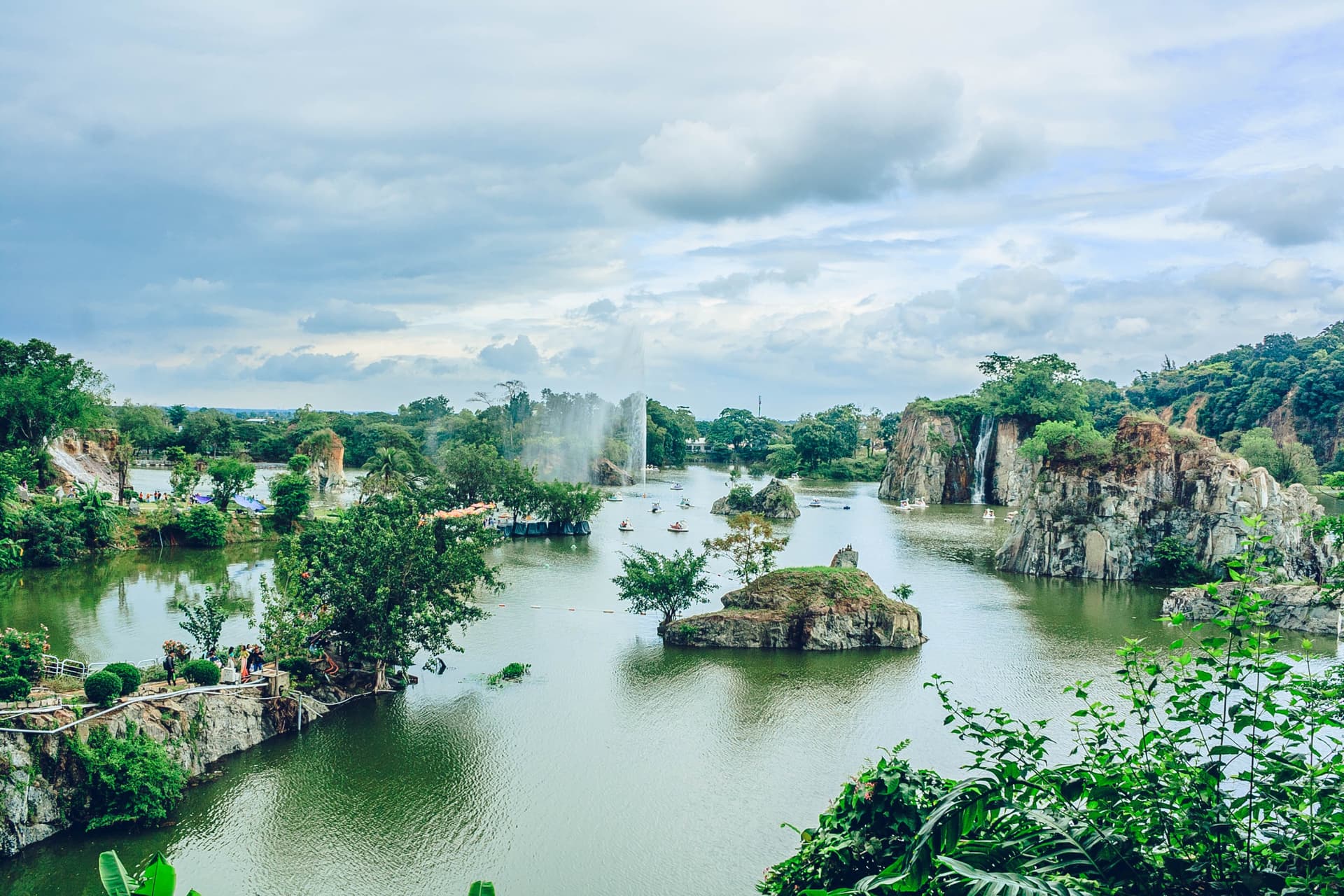
About thirty kilometers northeast of Ho Chi Minh City, Buu Long Mountain overlooks a landscape of karst hills and emerald lakes that earned it the nickname — often considered excessive — of the "South's Ha Long Bay." The site, located in Bien Hoa territory in Dong Nai Province (not Long An Province, despite frequent confusion with Long An Lake at its foot), combines a panoramic summit, an ancient Buddhist pagoda and a revered cave. It's one of the most accessible nature escapes from the southern metropolis.
Why visit Buu Long Mountain
Buu Long Mountain offers a rare green retreat in the immediate vicinity of Ho Chi Minh City, without the long journeys required by other natural sites in southern Vietnam. Several reasons make it worth the detour:
- A panoramic view over Dragon Lake (Long An) from the summit, particularly photogenic late in the morning.
- An ancient religious complex, the Buu Phong Pagoda, among the oldest Buddhist structures in the southern region.
- Accessible terrain for families, requiring no technical climbing.
- A more local atmosphere than Bà Den Mountain, its better-known mountainous equivalent on tourist circuits.
The nickname "South's Ha Long Bay," often repeated by local agencies, should be taken with caution: the scale and relief are in no way comparable to the authentic Ha Long Bay. Yet the contrast between rocky peaks and lake waters justifies half a day on site.
History of the site and Buu Phong Pagoda
The Buu Phong Pagoda, clinging to the mountain's slope, is traditionally dated to the 17th century, with a foundation attributed to 1676 by a monk from South China. The building underwent several reconstructions and successive expansions through the contemporary era, explaining the diversity of styles visible today — layered roofs adorned with dragons, polychrome statues, altars embedded in the rock.
The mountain itself was only developed as a tourist site in the late 20th century, when Dong Nai provincial authorities decided to enhance the old stone quarries whose exploitation had carved out the basins now filled with water. The Dragon Lake and other water bodies in the park are therefore remnants of an industrial activity repurposed, adding an unexpected historical dimension to the site.
What to see on site
The summit and panorama
The ascent is short — plan for twenty to thirty minutes of walking on a well-maintained trail. From the highest point, the view encompasses the lakes below, limestone peaks and, on clear days, the distant silhouette of the Bien Hoa plain.
Buu Phong Pagoda
Located halfway up the slope, it can be visited freely. Worshippers leave incense and offerings, particularly on full moon days of the lunar calendar. Appropriate dress required (shoulders and knees covered).
Long Dau Thach Cave
This natural cavity, integrated into the visiting route, houses Buddhist altars and maintains a pleasant coolness during extreme heat. Its name evokes the "dragon's head" and echoes the neighboring lake's topography.
The landscaped park around the lakes
The lakeside area is developed for strolling, with viewpoints and small boat docks offering tours. The whole area can be explored in half a day.
Practical information
- Visit duration: plan 2 to 3 hours on site, more if you combine a boat tour and lunch.
- Entry fee: moderate park entry, extra for water activities.
- Best time: early morning for light on the lakes and to avoid heat; dry season (December to April) for comfortable walking.
- What to bring: grip shoes, water, hat and covering clothes for the pagoda.
- Crowding: heavy on weekends with local visitors; prefer weekdays.
How to get there from Ho Chi Minh City
Buu Long Mountain is about 30 km from central Ho Chi Minh City, in Buu Long commune, Bien Hoa city, Dong Nai Province. Several options are available:
- Private car with driver: the simplest solution. Plan 1 to 1.5 hours depending on traffic, which can be heavy around the Dong Nai River bridge.
- Taxi or ride-hailing (Grab): feasible for the outbound journey, more unpredictable for the return; arrange a wait time with your driver.
- Motorcycle: an option for travelers experienced in Vietnamese traffic, via Highway 1A then the provincial road.
- Local bus: possible but lengthy, with a connection in Bien Hoa.
What to combine nearby
Buu Long Mountain integrates well into a program exploring natural landscapes in Vietnam, complementing the country's must-see sites:
- Bà Den Mountain, the southern region's highest peak, about three hours' drive west of Ho Chi Minh City.
- Cai Rang Floating Market, in the Mekong Delta, for a longer excursion from the metropolis.
- Cham Sculpture Museum in Da Nang, for travelers continuing toward central Vietnam.
- Cat Ba Island, a northern counterpoint for comparing southern karsts with the authentic Ha Long Bay.
Frequently asked questions
Frequently asked questions
Incorporating Buu Long Mountain into your trip
This green escape works well as a buffer day between arrival in Ho Chi Minh City and departure for the Mekong Delta or central Vietnam. To build a custom itinerary combining nature, heritage and southern cities, consult our Vietnam travel suggestions.
Interested in this visit?
We can include it in your personalised itinerary.