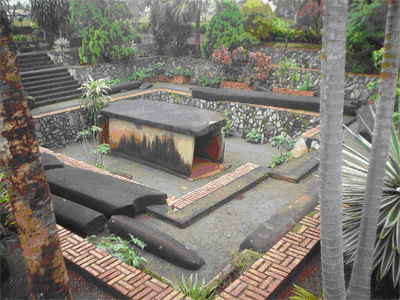
Hang Gon Tomb
Hang Gon Tomb
In Xuan Loc, Dong Nai province, the megalithic Hang Gon tomb bears witness to a 2,000-year-old funerary culture, still largely enigmatic.
The Hang Gon tomb, a megalith two millennia old
About a hundred kilometers northeast of Ho Chi Minh City, in Dong Nai province, the megalithic Hang Gon tomb stands as one of the most intriguing archaeological remains in southern Vietnam. This structure made of granite blocks, located in Hang Gon commune near Xuan Loc city, bears witness to an ancient funerary culture whose contours remain partially obscure. The site attracts above all travelers curious about archaeology and lovers of heritage sites less frequented than Vietnam's classic destinations.
Why visit the Hang Gon tomb
Hang Gon is not a spectacular site in the conventional tourism sense. It is a place for those interested in prehistoric civilizations of Southeast Asia, in dolmens and megalithic structures rare in this region. A visit takes only tens of minutes, but it offers concrete insight into a very ancient period of Vietnam, long before the imperial dynasties and Chinese or Cham influences.
- A rare megalith: few burial structures of this type exist in Vietnam.
- A tomb dating back approximately 2,000 years, from the end of the Iron Age.
- A site designated as Vietnamese national heritage, away from mass tourism circuits.
- A complementary stop for travelers heading toward Da Lat or the southern Vietnamese coast.
History and archaeological hypotheses
The Hang Gon tomb was uncovered in the 1990s on the territory of Xuan Loc city, in an area now covered with rubber plantations. Excavations revealed a funeral chamber formed by large granite slabs, some weighing several tons, assembled according to a plan reminiscent of dolmens known elsewhere in Asia and Europe.
Vietnamese archaeologists generally connect the site to pre-Sa Huynh culture or its local extensions, to an era when southern communities practiced complex funerary rites. According to published analyses, bodies were cremated before being placed inside the structure, sometimes accompanied by ceramic or metal objects. Inscriptions carved inside the tomb have been recorded, but their meaning remains unknown: they do not correspond to any identified writing system, fueling hypotheses about symbolic or ritual notation.
Several questions remain open: who commissioned this monument, how were the blocks transported and carved, what was the social status of the deceased. Research continues, and each excavation campaign brings new insights.
What you will see on site
The site presents itself as a modest archaeological enclosure. You will find:
- The main funeral chamber in granite slabs, partially reconstructed for conservation.
- Explanatory panels in Vietnamese, sometimes accompanied by English translations.
- A few movable artifacts displayed on site or evoked through reproductions.
- A rural setting, surrounded by plantations, which reflects the agricultural landscape of Dong Nai region.
Allow 30 minutes to 1 hour for your visit, depending on your interest in archaeological explanations.
Practical information
- Location: Hang Gon commune, Xuan Loc city, Dong Nai province.
- Duration of visit: 30 minutes to 1 hour.
- Admission: free entry or symbolic contribution depending on the period.
- Best season: the dry season, from November to April, to avoid tropical downpours.
- What to bring: water, hat, closed-toe shoes, as shade is limited on site.
How to get there
Xuan Loc is located approximately 80 km east of Ho Chi Minh City, on National Highway 1A heading toward Phan Thiet. Several options are available:
- Private car with driver: the most practical solution, approximately 2 hours travel from Ho Chi Minh City depending on traffic.
- By bus: regular connections link Ho Chi Minh City to Xuan Loc, then local taxi or motorbike taxi to the site.
- By train: Xuan Loc station is served by the north-south line, but frequency is limited.
The site is not systematically signposted: it is useful to ask a local driver or guide, or to prepare your itinerary in advance with GPS coordinates.
Nearby attractions and beyond
The Hang Gon tomb is part of a network of historical and natural sites in southern Vietnam. To extend your exploration, you may consider:
- The Buu Long mountain and Long An, a karst landscape at the gates of Ho Chi Minh City.
- The Ba Den mountain, the highest point in southern Vietnam and a pilgrimage site.
- The Cham Sculpture Museum in Da Nang, a useful complement to understanding Vietnam's ancient civilizations.
- The Cai Rang floating market in the Mekong Delta, for an immersion in southern culture.
Frequently asked questions
Frequently asked questions
For travelers passionate about archaeology or little-known heritage, yes. For a first Vietnam trip focused on landscapes and iconic cities, the site remains secondary.
Archaeological estimates place its construction approximately 2,000 years ago, at the end of the Iron Age.
Their meaning remains unknown to date. They do not correspond to any identified writing system and are the subject of various hypotheses among researchers.
Yes, Xuan Loc lies on the Ho Chi Minh City – Phan Thiet – Da Lat axis, making it possible to include this stop in an itinerary toward the southern coast or the Highlands.
Preparing your Vietnam trip
The Hang Gon tomb is just one fragment of Vietnam's archaeological and cultural heritage. To build a coherent itinerary, from the Mekong Delta to the northern mountains, explore our Vietnam travel packages and design a stay tailored to your interests.
Interested in this visit?
We can include it in your personalised itinerary.