Other Places of Worship
Other Places of Worship
Vietnamese and Chinese pagodas, Hindu temples, colonial churches and Tamil mosques: an overview of the places of worship in Ho Chi Minh City.
Ho Chi Minh City brings together within its territory a mosaic of places of worship that reflects the spiritual diversity of southern Vietnam. Vietnamese Buddhist pagodas, Chinese temples built by congregations in Cholon, Tamil Hindu sanctuaries, Catholic churches inherited from the French period, and Indian or Tamil mosques stand side by side just kilometers apart. Together, they compose a singular religious journey, bearing witness to the migrations, dynasties, and colonial influences that shaped ancient Saigon.
Why visit these places of worship?
- Rare religious diversity: Mahayana Buddhism, Chinese Taoism, Tamil Hinduism, Catholicism, and Islam coexist within the same urban area.
- Contrasting architectures: Japanized towers, rooflines with upturned eaves adorned with dragons, blue and white minarets, neo-Gothic facades.
- Striking historical narratives: immolations of Buddhist monks in 1963, presidential refuge during the November 1963 coup, the heritage of Chinese congregations in Cholon.
- A thematic approach to the city, complementing the major classic tourist sites.
What to see?
Vietnamese Buddhist pagodas
Dai Giac Pagoda
Built in the 1960s, Dai Giac Pagoda is recognizable by the unfinished tower that rises in its courtyard. The sanctuary houses representations of the Goddess of Mercy and the Buddha.
Vinh Nghiem Pagoda
Built in 1971 with the support of a Japanese friendship association, Vinh Nghiem Pagoda stands out for its eight-level tower, each level housing a Buddha statue. Several Japanese architectural elements are integrated into its structure, making it a singular case in the Vietnamese Buddhist landscape.
Xa Loi Pagoda
Constructed in 1956, Xa Loi Pagoda preserves a relic of the Buddha. It witnessed several immolations of Buddhist monks denouncing the South Vietnamese regime and American aggression, events that marked the country's political history. Access to the sanctuary follows a traditional rule: men use the left staircase, women the right. Several frescoes depicting scenes from the Buddha's life adorn the interior walls.
Pagodas of Chinese congregations
Phung Son Tu Pagoda
Built by the Fujian congregation in the 1940s, this pagoda is dedicated to the worship of Ong Bon, guardian of Happiness and Virtue. A representation of the Goddess of Mercy stands to the right of Ong Bon. The atmosphere is filled with the fragrances of incense.
Nghia An Hoi Quan Pagoda
Erected by the Chinese Chaozhou congregation, Nghia An Hoi Quan Pagoda houses an imposing statue of Quan Cong's red horse, as well as representations of Ong Bon, Quan Cong, Chau Xuong, Quan Binh, and Thien Hau. The gilt wood bas-reliefs count among its most remarkable decorative elements.
Ong Bon Pagoda
Built by the Fujian congregation in honor of Ong Bon, this pagoda assembles statues of Quan The Am Bo Tat, Buddha Thich Ca, Ong Bon, and Quan Cong. A fresco depicting five tigers and two dragons adorns the sanctuary.
Ha Chuong Hoi Quan Pagoda
Dedicated to Thien Hau, goddess of the Sea, the pagoda rests on four stone pillars carved in China and then transported to the site. The main festival takes place on the 15th day of the 1st lunar month and features a lantern procession.
Vietnamese and Hindu temples
Mariamman Temple (Chua Ba Mariamman)
Built in the late 19th century by the Tamil community, the temple is dedicated to the Hindu goddess Mariamman, to whom popular belief attributes protective virtues. In the sanctuary, the goddess is flanked by her two guardians, Maduraiveeran and Pechiamman, before two lingas.
Tran Hung Dao Temple
Erected in 1958 on the site of the former Van An pagoda, this temple is devoted to Tran Hung Dao, a national hero who repelled Mongol forces in 1287, traditionally estimated at 300,000 men according to historical sources. Its style draws inspiration from temples and communal houses of the North. It adopts a T-shape, with two superimposed rooflines with upturned eaves adorned with dragons and phoenixes. Inside, lacquered panels, sculptured and inlaid incense burners, and murals recount the general's epic. Commemorative ceremonies take place during Tet and on the 20th day of the 8th lunar month.
Le Van Duyet Temple
The temple houses the tombs of Marshal Le Van Duyet (1763-1831) and his wife. Elevated to the rank of marshal by Emperor Gia Long, Le Van Duyet fell into posthumous disgrace under Minh Mang before being rehabilitated by Thieu Tri. Pilgrims gather here during Tet and on the 30th day of the 7th lunar month.
Catholic churches
Cho Quan Church
Built by the French about a century ago, Cho Quan Church ranks among the largest Catholic buildings in Ho Chi Minh City. Its silhouette rises above the surrounding neighborhood.
Cha Tam Church
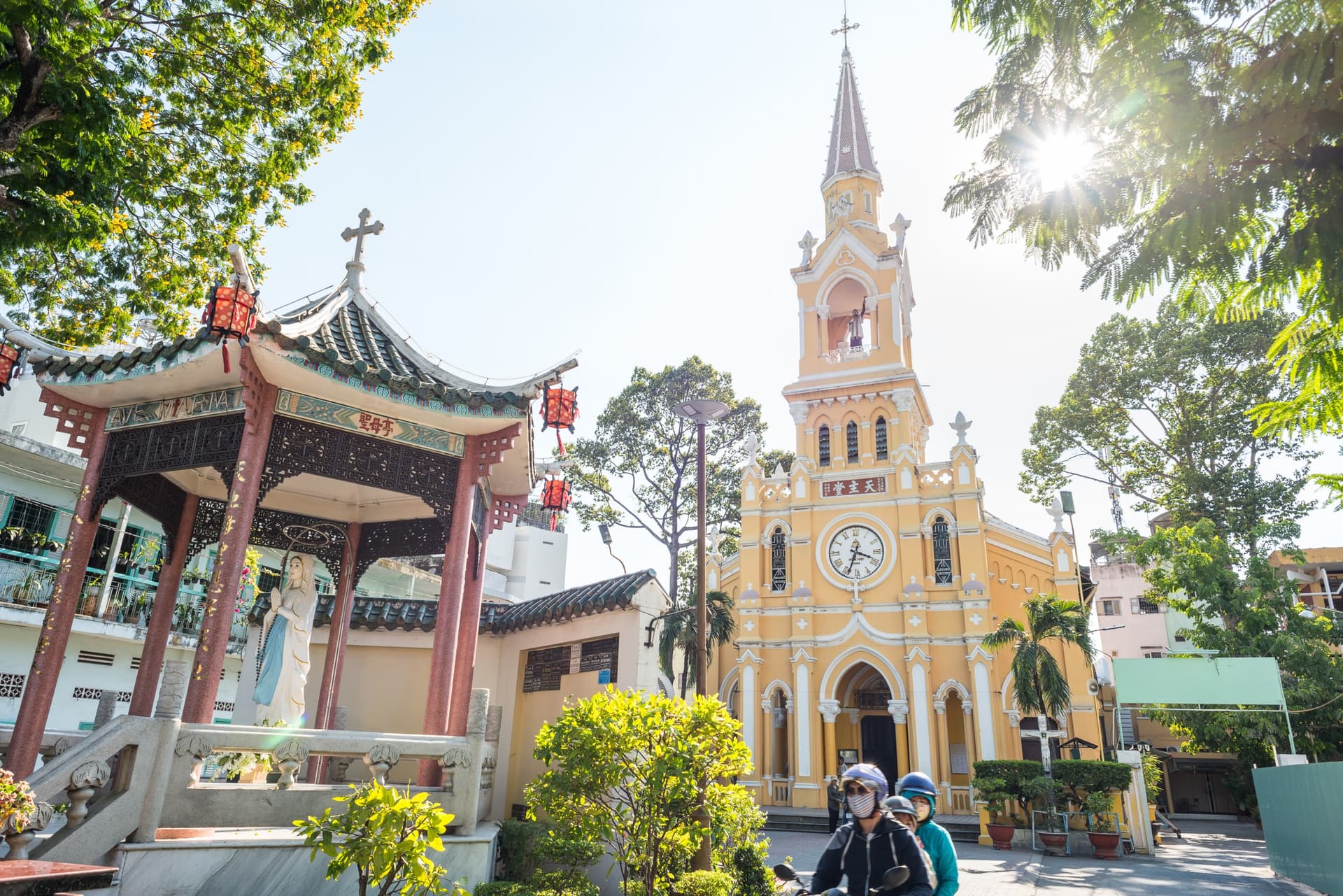
The white and yellow church of Cha Tam was built toward the end of the 19th century. A statue represents Monsignor François-Xavier Tam Assou (1855-1934), an apostolic vicar of Chinese origin. During the November 2, 1963 coup, President Ngo Dinh Diem and his brother Ngo Dinh Nhu took refuge here before being arrested, an event that marked the place's memory.
Mosques
Saigon City Center Mosque
Built in 1935 by Muslims from southern India on the site of a former mosque, the building stands out for its white and blue facade and four minarets.
Cholon Mosque
Built in 1932 by Tamil Muslims, the Cholon Mosque features a mihrab, a niche set into the wall indicating the direction of Mecca.
Practical information
- Access: most places of worship are accessible by taxi or motorbike taxi from downtown Ho Chi Minh City. Chinese pagodas are concentrated in the Cholon area (District 5), while Vietnamese pagodas and churches are scattered across Districts 1, 3, and 10.
- Dress code: shoulders and knees covered to enter pagodas, temples, and mosques. Shoes must be removed in Hindu sanctuaries and mosques.
- Hours: most places open during the day. Morning visits are preferable to observe the faithful and avoid the heat. Fridays (mosques) and lunar festival days see increased crowds.
- Entrance: generally free. A discreet donation is appreciated at pagodas.
- Behavior: silence, photos without flash, do not turn your back to altars and do not point your finger at statues.
Nearby
To extend your visit to Ho Chi Minh City and its surroundings, several sites complement this religious journey:
- The botanical garden and zoo, a historic green space in the city center.
- Buu Long Mountain and Long An, a nature getaway near the metropolis.
- The Ba Den Mountain, a major Buddhist pilgrimage site in southern Vietnam.
- Ba Chuc, a memorial site in An Giang Province.
Planning your trip
These places of worship fit naturally into a deeper discovery of southern Vietnam. To build a tailor-made itinerary blending religious heritage, colonial history, and Mekong Delta landscapes, explore our Vietnam travel suggestions.
Interested in this visit?
We can include it in your personalised itinerary.