Tam Son Hoi Quan Pagoda
Tam Son Hoi Quan Pagoda
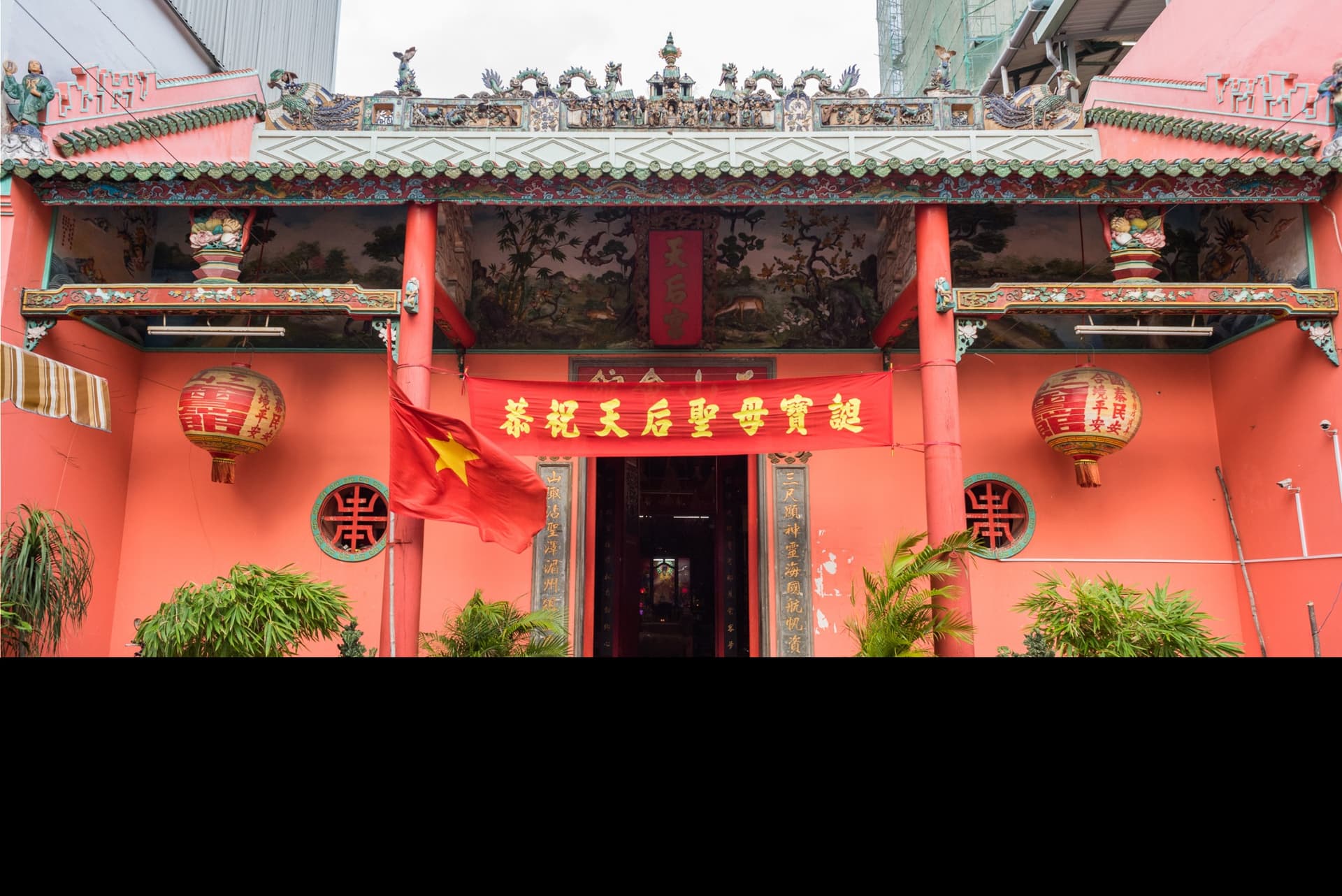
A Sino-Vietnamese temple in Cholon district, Tam Son Hoi Quan Pagoda, founded by the Fujian congregation, is dedicated to the goddess of Fertility Me Sanh.
The Tam Son Hoi Quan Pagoda is a Sino-Vietnamese temple located in the Cholon district of Ho Chi Minh City (District 5). Built by the Chinese Fujian congregation, it remains an active place of worship, particularly frequented by couples who come to pray to the goddess of Fertility Me Sanh for children. Less prominent than its neighbours Thien Hau or Quan Am, it offers a brief but richly rewarding visit, full of statuary and symbolism.
Why Visit Tam Son Hoi Quan Pagoda
This pagoda holds three main points of interest. First, it illustrates the Fujian Chinese presence in southern Vietnam, one of five major congregations that shaped Cholon from the 18th century onwards. Second, its pantheon blends Taoist deities, deified historical figures and popular goddesses, making it a textbook case for understanding Chinese popular religion overseas. Finally, it remains very much a local place of worship: you'll encounter more faithful worshippers than tourists, an atmosphere conducive to quiet observation.
History and Origins
The pagoda was built by the Chinese Fujian congregation in the 19th century (some sources cite earlier foundations dating back to the 18th century), in honour of the goddess of Fertility Me Sanh. At that time, hui guan — communal houses of Chinese congregations — served simultaneously as places of worship, mutual aid centres and rallying points for merchants from the same Chinese province.
The term "Tam Son" refers to the three mountains of Fujian, and "Hoi Quan" designates precisely the communal house. To this day, the pagoda welcomes many men and women coming to pray for children, perpetuating a tradition spanning more than two centuries.
What to See Inside
The building is organized around an inner courtyard and a richly decorated main hall. Several effigies are venerated here:
- Representations of the deified general Quan Cong, a figure of loyalty and righteousness from China's Three Kingdoms era.
- The general mandarin Chau Xuong, loyal companion-in-arms of Quan Cong, typically depicted wielding the famous halberd.
- The administrative mandarin Quan Binh, adopted son of Quan Cong, completing the martial triad.
- The sacred red horse of Quan Cong, a mythical steed often placed in a side niche and touched by the faithful as a sign of respect.
- The goddess of the Sea Thien Hau, protector of sailors and migrants, present in most Chinese temples throughout southern Vietnam.
- The goddess of Fertility Me Sanh, the tutelary deity of this place, to whom prayers for offspring are addressed.
Also observe the gilded wood carvings, lacquered panels bearing parallel sentences in Chinese characters, and the incense spirals suspended from the ceiling, whose burning can last for several weeks.
Practical Information
- Location: Trieu Quang Phuc street, District 5 (Cholon), Ho Chi Minh City.
- Hours: open daily during daytime, generally from morning until late afternoon.
- Admission: free entry. A donation for incense sticks is appreciated.
- Visit Duration: 20 to 30 minutes are sufficient; allow more time if you combine it with nearby pagodas.
- Dress Code: shoulders and knees covered out of respect for the place of worship.
- Photography: generally permitted, avoid during prayers.
How to Get There
The pagoda is located in the heart of Cholon, approximately 6 km from Ho Chi Minh City's city centre (District 1). Several options are available:
- By taxi or ride-sharing (Grab, Be): expect 15 to 25 minutes from the Ben Thanh area, depending on traffic.
- By city bus: several lines serve Cholon from the city centre at very modest fares.
- On foot from Binh Tay Market or Thien Hau Pagoda: 10 to 15 minutes.
What to Combine in the District
Cholon concentrates around a dozen Chinese temples within a few streets, making it easy to visit several in succession. The Thien Hau, Quan Am and Nghia An Hoi Quan pagodas are all within a ten-minute walk. Binh Tay Market, a vast colonial building, rounds out a tour of the district. To extend your discovery of Vietnam beyond the city, the Cai Rang floating market in the Mekong Delta and Ba Den Mountain in Tay Ninh are accessible as day excursions. Nature enthusiasts can also reach Buu Long Mountain near Bien Hoa, or further afield, Cat Ba Island to the north and the Cham Sculpture Museum in Da Nang.
Planning Your Visit
Tam Son Hoi Quan Pagoda fits naturally into a half-day itinerary in Cholon, to be combined with other Chinese temples and Binh Tay Market. To build a complete stay blending Ho Chi Minh City, the Mekong Delta and central Vietnam, explore our Vietnam trips and let our local experts guide you.
Nearby

Interested in this visit?
We can include it in your personalised itinerary.