The Municipal Theater
The Municipal Theater
Colonial opera house inaugurated in 1899 on Dong Khoi Street, the Municipal Theater of Ho Chi Minh City hosts acrobatics, concerts, and ballets today.
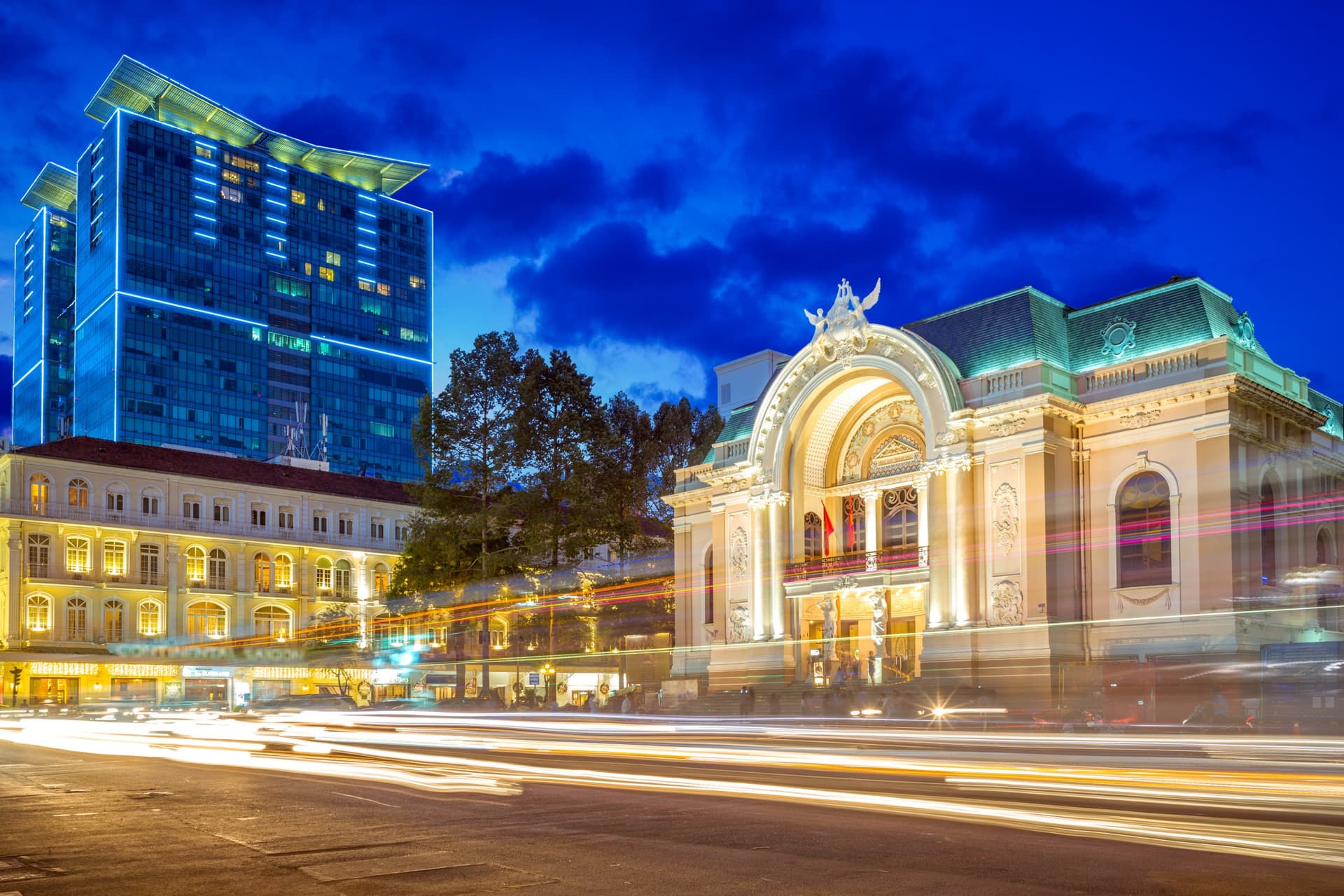
Built in 1899 on what is now Dong Khoi Street, the Municipal Theater of Ho Chi Minh City (Saigon) ranks among the emblematic buildings of French colonial architecture in the city center. Designed as an opera house in the late 19th century, it passed through a turbulent century of history before reclaiming its cultural vocation. Its ornate façade, statues, and sculpted pediment make it an immediate landmark on Lam Son Square, between the Caravelle Hotel and the Continental.
Why visit the Municipal Theater
The Municipal Theater, also called the Saigon Opera, holds interest on several counts. First, it stands as a testament to French urban planning in Indochina, preserved in its original envelope and restored in the 1990s. Second, it is a living performance venue that hosts varied programming each week. Finally, its central location on Dong Khoi places it on the natural route of visitors exploring District 1, minutes away from Notre-Dame Cathedral and the Central Post Office.
Attending a performance remains the best way to access the carefully restored interior. Failing that, the exterior deserves a stop for the quality of its sculpted decoration and the perspective it offers onto Lam Son Square.
A history in several lives
Inaugurated in 1900 after several years of construction (the first stone was laid in 1898, the building completed in 1899), the theater is the work of architect Eugène Ferret, who drew openly from Paris's Petit Palais. The façade combines pilasters, allegorical statues, and sculpted motifs characteristic of late-century eclecticism. The hall, designed for roughly 800 spectators, originally welcomed operatic troupes from France.
The building's story shifted in the mid-20th century. Under the South Vietnam Republic, it was repurposed and served as the seat of the South Vietnamese National Assembly, temporarily losing its theatrical function. After 1975, it saw several uses before a restoration undertaken in the 1990s, marking Saigon's tercentenary (1998), restored its role as a performance hall. The façade ornaments, simplified over the decades, were then largely reinstated.
What to see and do on-site
The exterior architecture
The main façade, facing Dong Khoi, features a pediment framed by two female statues bearing a medallion. Details worth observing:
- the carved caryatids and angels at the main entrance;
- the pilasters rhythming the façade;
- the sculpted medallions and garlands;
- the perspective from Lam Son Square, particularly photogenic in late afternoon light.
Programming
Weekly programs cover a broad repertoire: acrobatic shows, pop concerts, ballets, classical concerts, and contemporary creations. Two productions return regularly and appeal especially to international visitors:
- A O Show, an acrobatic and contemporary circus spectacle built around bamboo and rural traditions of the South;
- The Mist, a choreographic creation inspired by Vietnamese rice-farming culture.
Performances take place in the evening, sometimes as matinees on weekends. The box office is at the building entrance and tickets are available online through production websites.
Practical information
- Address: 7 Lam Son Square, Dong Khoi Street, District 1, Ho Chi Minh City.
- Access: in the heart of District 1, walkable from Ben Thanh, Notre-Dame Cathedral, or central hotels. Taxis and ride-sharing services drop off directly on Lam Son Square.
- Interior visit: this happens primarily by attending a performance. No regular daytime guided tours are offered.
- Duration: allow 15 to 20 minutes for the façade and surrounds, 1.5 to 2 hours for a performance.
- Admission: free to view the exterior; performance tickets range from moderate to premium depending on the production and seat category.
- Best time: late afternoon for light on the façade, evening for performances. The building is illuminated at night.
What to combine nearby
The Municipal Theater fits naturally into a day exploring Ho Chi Minh City's historic center. Within a 500-meter radius on foot: Notre-Dame Cathedral of Saigon, the Central Post Office designed in the circle of Gustave Eiffel, City Hall, and Ben Thanh Market. Once Saigon is explored, the journey can extend into the Mekong Delta with Cai Rang Floating Market, or toward nearby natural spaces like Buu Long Mountain. For those interested in ancient art, the Cham Sculpture Museum in Da Nang enriches understanding of Vietnamese heritage, while Ba Den Mountain offers a different perspective on the South.
Preparing your visit
The Municipal Theater finds its natural place within an itinerary including Saigon, the Mekong Delta, and the country's cultural highlights. To build a tailor-made itinerary incorporating colonial heritage and contemporary Vietnamese creation, explore our Vietnam voyages.
Interested in this visit?
We can include it in your personalised itinerary.