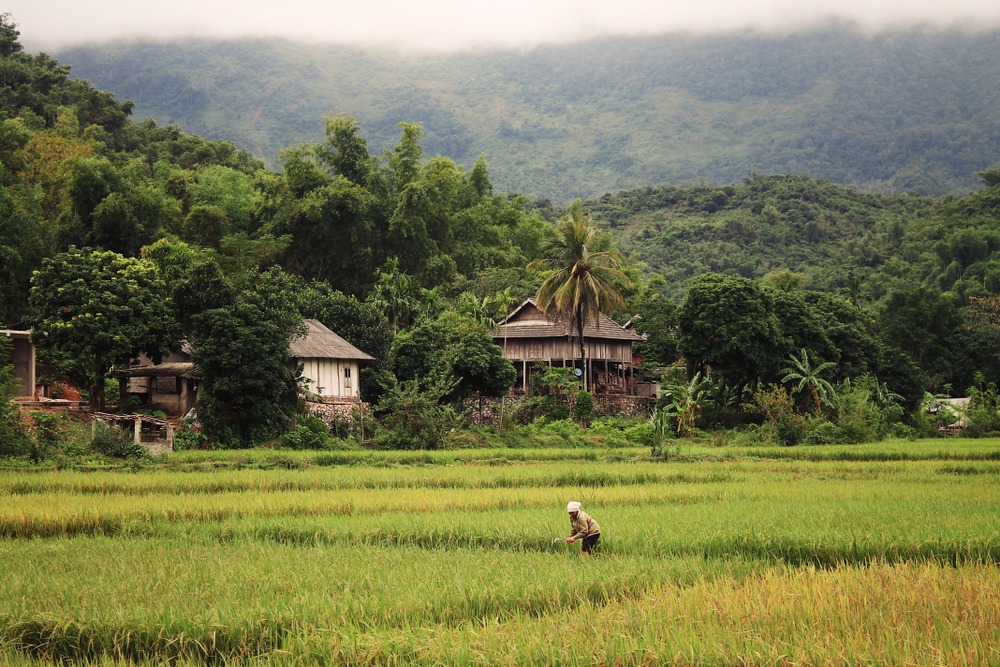
Red River Delta
Surrounding Hanoi, the Red River Delta unites the millennial capital, the limestone karsts of Halong Bay and the flooded rice paddies of Ninh Binh across a triangle spanning 170 km.
The Tonkin Delta stretches across nearly 15,000 km² around the Red River, the Song Hong, which descends from China's Yunnan province and empties into the South China Sea near Thai Binh. It was here, in this dense and flat alluvial plain, that Vietnamese civilization took shape over two thousand years ago. The delta today concentrates around 23 million inhabitants, intensive rice cultivation yielding two harvests annually, and a network of villages specialized in precise crafts: ceramics in Bat Trang, silk in Van Phuc, lacquered wood in Ha Thai, popular woodblock prints in Dong Ho. This village specialization, inherited from the phuong system, also explains the organization of old Hanoi into 36 corporate streets.
Hanoi remains the anchor point. The capital has preserved a readable ancient layout: Hoan Kiem Lake at its center, the French colonial quarter to the south with the Opera House and Saint-Joseph Cathedral, the 36 Streets quarter to the north with its narrow tube houses, and further west the imperial Thang Long Citadel, inscribed by UNESCO in 2010. We recommend spending two full days there, walking early in the morning around the lake when locals practice tai-chi, then settling at a street corner for bun cha (grilled pork, vermicelli, fresh herbs) or pho bo served between 6am and 10am.
Some 170 km to the east, Halong Bay and its neighbor Lan Ha Bay form a landscape of limestone karsts emerging from shallow seas. Nearly 1,969 limestone islets dot the entire area. Halong receives the bulk of visitors, with departures concentrated from Tuan Chau. We tend to guide our travelers toward Lan Ha, accessible from Cat Ba, where the number of permitted junks remains limited and where one can still encounter active floating villages, such as Cai Beo. A single night on board suffices; two if you wish to add kayaking between the islets.
Southwest of Hanoi, around 95 km away, Ninh Binh represents the third pole of the delta. It is sometimes called the terrestrial Halong Bay: the same limestone karsts, but this time emerging from rice paddies and inland rivers. The boats of Trang An, maneuvered by oars or feet by women from surrounding villages, traverse a succession of caves ranging from 100 to 800 meters long. Nearby, the ancient capital of Hoa Lu (10th and 11th centuries) precedes Hanoi in dynastic history, and the Buddhist complex of Bai Dinh, built between 2003 and 2010, houses Southeast Asia's largest bronze Buddha statue.
Delta culture expresses itself through living traditions: ca tru, a sophisticated three-instrument chant inscribed on UNESCO's heritage list, and mua roi nuoc, water puppet theater born in the delta's rice paddies in the 11th century, still performed daily at Hanoi's Thang Long Theater. At table, the delta has given the country several of its most iconic dishes: pho bo, banh cuon (steamed rice dumplings), cha ca with turmeric fish and dill, and egg coffee invented in Hanoi in 1946 at Giang.
The climate is humid subtropical, with marked seasonal variation that profoundly transforms the landscapes: heavy luminous summers over green rice paddies, gray misty winters that soften the contours of limestone karsts. This variation, more than rainfall itself, determines the impression the delta will leave on you.
Must-see
Old Quarter of 36 Streets, Hanoi. Half-day walk through specialized streets (Hang Bac for silver, Hang Gai for silk), tube houses just 2 meters wide, and stops in pho and bun cha shops between neighborhood temples.
Night aboard a junk in Lan Ha Bay. Departure from Cat Ba Island for 24 hours on board, anchoring away from Halong's busy circuits, kayaking in late afternoon between the karsts and passing the floating fishing village of Cai Beo.
Trang An boats and Hoa Lu. Three hours of rowing navigation through nine limestone caves and three isolated temples on the riverbanks, followed by a visit to the Dinh and Le temples, remnants of the 10th-century capital.
Water puppets at Thang Long Theater. One-hour performance accompanied by a traditional orchestra, an art born in the delta's flooded rice paddies nearly a thousand years ago, best seen in late afternoon after exploring the old quarter.
Bat Trang ceramics village. 13 km from central Hanoi on the left bank of the Red River, a ceramics workshop active since the 14th century, where you can throw your own piece and observe traditional kilns.
When to visit
The delta experiences four relatively pronounced seasons, distinguishing it from the country's south. From October through early December, the air is dry, temperatures range between 20 and 27°C, and light remains sharp over rice paddies in their final cycle: this is the window we most recommend. From late December through March, the delta enters a humid and cold winter, with temperatures potentially dropping to 12-15°C in Hanoi, low skies and persistent drizzle called mua phun. Halong and Ninh Binh's limestone karsts take on a more mineral character, though bay visibility diminishes.
From April to June, heat gradually climbs toward 30-34°C with strong humidity. July through September marks the rainy season and typhoon period: cumulative precipitation of 250 to 350 mm monthly in July-August, and a real risk of Halong Bay closure for 24 to 72 hours during storm alerts. We avoid scheduling junk nights between mid-July and mid-September. Conversely, this is when Ninh Binh's rice paddies are intensely green, just before the late May-early June harvest and the October one.
Practical tips
Six to seven days is the minimum duration to explore the Hanoi - Halong/Lan Ha - Ninh Binh triangle without heavy rain: two days in the capital, two days and one night in the bay, two days in Ninh Binh with an overnight stay. Distances are short (170 km to Halong, 95 km to Ninh Binh) and entirely covered by highway since 2019, bringing each journey down to 2 to 2.5 hours by private car. Noi Bai international airport, 27 km north of Hanoi, is the logical entry point, with direct flights from Paris.
The delta naturally combines with the mountainous North for travelers wishing to add Sapa or Ha Giang terraced rice paddies (plan 4 to 6 additional days), or with the Imperial Center via a one-hour domestic flight Hanoi-Hue or Hanoi-Da Nang. Comfort levels are high: charming hotels in Hanoi, junks with air-conditioned cabins in the bay, ecolodges in rice paddies in Ninh Binh. It's a region equally suited to families with children, thanks to short distances and varied activities, and to contemplative travelers drawn to history and material culture.