Islands and Coastline
3,260 km of coastline, from pristine islands like Con Dao to established resorts at Mui Ne and Nha Trang, as a natural extension to any Vietnam circuit.
Vietnam's coastline stretches 3,260 kilometers from Ha Long Bay to the Gulf of Thailand, concentrating remarkable diversity in beaches, islands, and microclimates. From our Hanoi office, we view this region as a circuit finale rather than a primary objective: Vietnam's richness remains continental, and beach zones primarily serve to rest travelers after ten or fifteen days of road travel and cultural immersion.
Three distinct areas structure the offering. In the south, within the Gulf of Thailand, Phu Quoc has evolved into a mass-market resort destination over the past fifteen years, complete with an international airport, beachfront hotels along Long Beach, and a cable car to Hon Thom. The island's north, around Bai Thom and Rach Vem, retains fishing villages and pepper plantations, though we rarely direct clients there unless specifically requested. Con Dao, an archipelago of sixteen islands off Vung Tau, offers an alternative we prefer: once a French penal colony, then South Vietnamese prison, now a national park, the main island combines empty beaches (Dam Trau, Bai Nhat), tropical forest, and green sea turtle nesting grounds on Bay Canh from June through September. A direct flight from Ho Chi Minh City takes 45 minutes.
Central coastline concentrates the historic resorts. Nha Trang, the seaside capital since the 1960s, now thrives on Russian and Korean tourism, with boat-accessible islands including Hon Mun for snorkeling. Further south, Mui Ne and Phan Thiet combine two geographical particularities: red sand dunes near the Fairy Stream and white dunes around Bau Trang Lake, remnants of an ancient shoreline. Sustained winds from November through March make this the primary kitesurfing and windsurfing destination in Southeast Asia. Farther north, Quy Nhon, long overlooked, preserves a mid-sized town atmosphere with its urban beach at Xuan Dieu, the Cham towers of Banh It, and the fishing port of Tan Phung.
Between Hue and Hoi An, the central coast offers beaches less exposed to international tourism: An Bang at Hoi An remains busy, but Lang Co, at the foot of Hai Van Pass, and the coves of Son Tra Peninsula at Da Nang allow brief stops along a circuit. Even further north, Cat Ba Island and the Bai Tu Long archipelago extend Ha Long Bay for those wanting to combine a junk cruise with beach time.
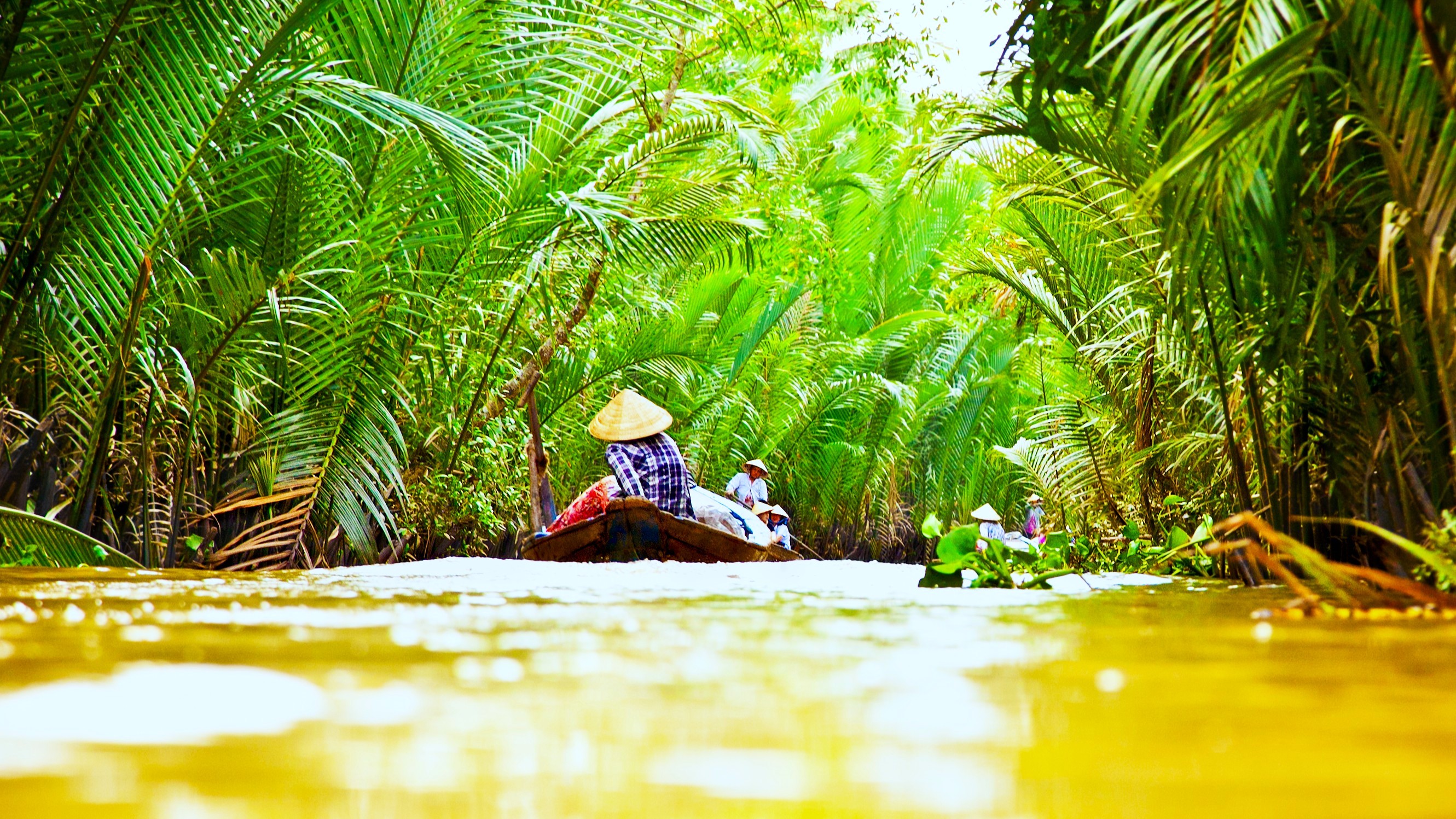
The local economy everywhere rests on coastal fishing and aquaculture: shrimp farming in Mekong Delta mangroves, pearl farms around Phu Quoc, nuoc mam production (Phu Quoc fish sauce has held a European protected geographical indication since 2013). Morning markets at Duong Dong, Con Son, or Quy Nhon offer direct glimpses of this activity, with catches returning between 5 and 7 a.m. On the table, southern classics appear (banh xeo, bun mam) alongside local seafood: green peppercorn crab Phu Quoc style, Nha Trang sea urchin grilled in peanut butter, Phan Thiet dried squid.
Our approach is therefore selective: we rarely propose the coast as a travel theme in itself, but as a coherent extension of a circuit. The choice among Con Dao, Phu Quoc, Mui Ne, and Quy Nhon depends on available duration, desired exit point, and the type of activity sought, from pure relaxation to biological diving.
Highlights
Turtle nesting at Bay Canh. On this small Con Dao island, green sea turtles come ashore to nest at night between June and September. Viewing occurs with national park rangers, in limited groups, with overnight camping on the island.
Red and white dunes at Mui Ne. The oxidized red sand dunes near the fishing village and white dunes around Bau Trang Lake offer two distinct landscapes 30 kilometers apart, most striking in late afternoon when wind subsides.
Cham towers around Quy Nhon. The complexes at Banh It, Duong Long, and Thap Doi, dating from the eleventh to thirteenth centuries, witness the Champa Kingdom that controlled this coastline. Seldom visited, they can be explored in a half-day trip from the city.
Duong Dong fish market. At Phu Quoc, the night market then the boat returns around 5 a.m. at the Duong Dong River dock reveal a fishing economy still active despite the island's tourism development.
Diving at Hon Mun. Off Nha Trang, the Hon Mun marine reserve remains Vietnam's most accessible diving site, with roughly twenty points between 5 and 18 meters and good visibility from March through September.
When to Go
The south (Phu Quoc, Con Dao, Mui Ne) follows a two-season pattern. Dry season, November through April, offers optimal conditions: air temperatures between 26 and 32°C, water at 26–28°C year-round, clear skies. Rainy season, May through October, brings late-afternoon showers and rough seas on Phu Quoc's west coast, while Con Dao remains accessible through September with the turtle nesting advantage. Mui Ne stands out for its strong thermal winds from November through March, ideal for kitesurfing but less pleasant for calm swimming.
Central coastline (Da Nang, Hoi An, Quy Nhon, Nha Trang) experiences a cool, humid season from December through February, with nighttime temperatures potentially dropping to 18–20°C and sea temperatures at 22–24°C. Typhoons occasionally strike between September and November, especially between Da Nang and Quy Nhon. The best window extends March through August, with a tourist peak in July-August tied to Vietnamese school holidays.
Practical Advice
We recommend 3 to 5 nights at a single beach destination at circuit's end, rarely more: beyond that, boredom settles in for most travelers seeking Vietnam's diversity. Con Dao requires a minimum of 3 nights given flight frequency (two to three daily from Ho Chi Minh City). Phu Quoc and Nha Trang have international airports enabling direct departure to Bangkok, Singapore, or Seoul. Mui Ne is reached by road from Ho Chi Minh City in 4 to 5 hours, making it the natural option after a South and Mekong Delta circuit.
Combinability depends on the traveler's arrival point. After an Imperial Center circuit around Hue and Hoi An, Quy Nhon or Nha Trang logically extend via the coast. After the Central Highlands, Mui Ne or Phan Thiet sit 4 hours from Da Lat. After the South and Mekong Delta, Phu Quoc or Con Dao close the journey by air. We avoid, however, chaining the mountainous North and southern islands without an intermediate cultural stop—the contrast becomes jarring. Comfort levels range from five-star international resort (Six Senses Con Dao, JW Marriott Phu Quoc) to simple beachfront guesthouses. The region suits contemplatives, families nearing journey's end, and divers; active travelers seeking discovery will prefer shortening the beach portion.